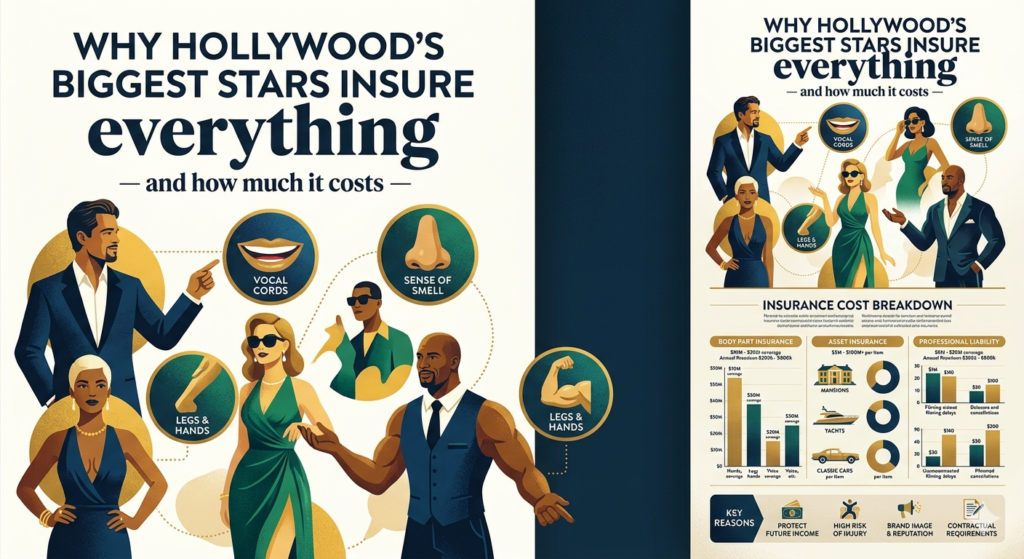
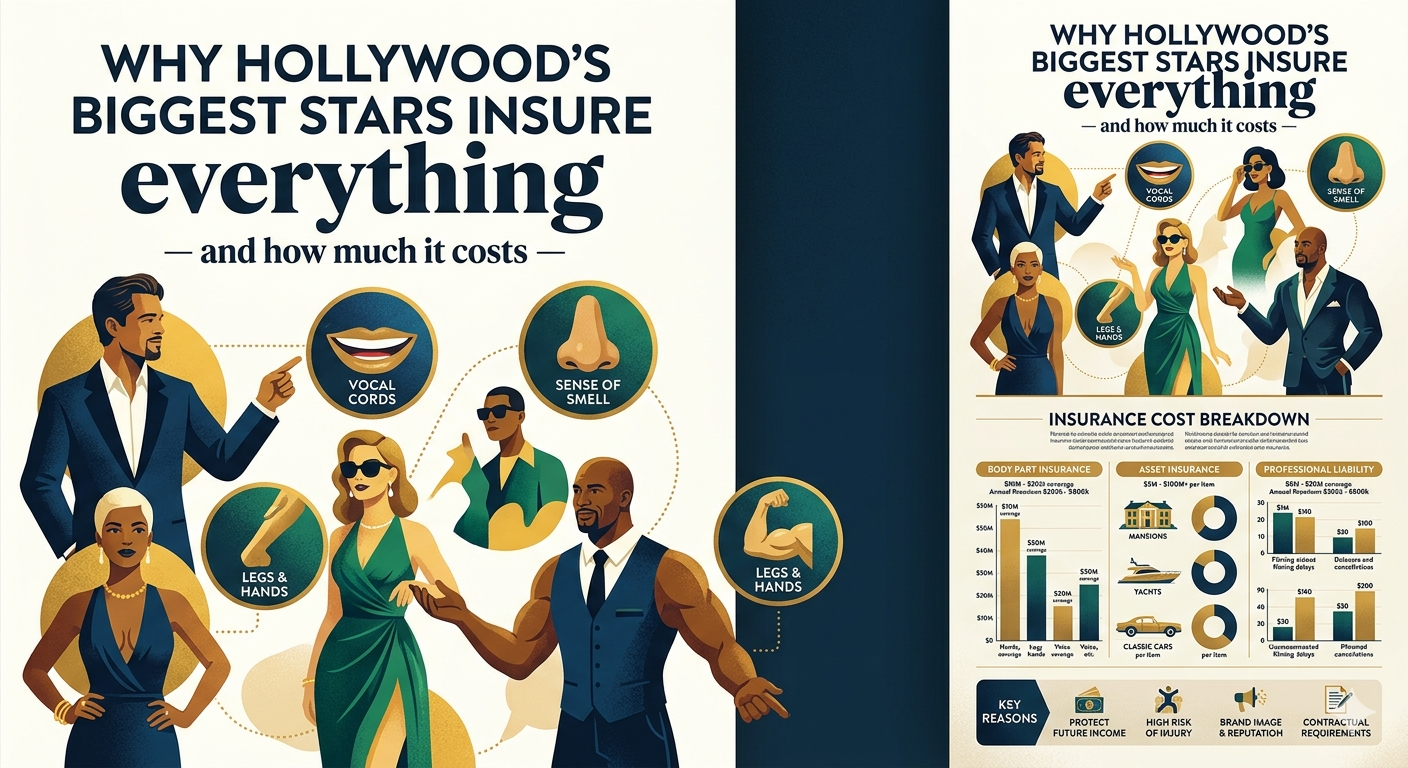
Why Hollywood’s Biggest Stars Insure Everything — And How Much It Costs
From Mariah Carey’s voice to Cristiano Ronaldo’s legs, body part insurance is Hollywood’s best-kept financial secret — and it reveals billions in risk.
- What celebrity insurance actually is
- Why stars need specialized coverage
- The wildest insured body parts
- Top 10 most insured celebrities
- Types of entertainment insurance
- Production insurance explained
- How much premiums really cost
- Your personal insurance calculator
- How to get similar coverage
- Frequently asked questions
What Is Celebrity Insurance — And Why Does It Exist?
Imagine your livelihood depending entirely on the health of your hands, your voice, your smile, or even a specific set of legs. For most people, that’s an abstract concern. For Hollywood’s elite, it’s a financial reality worth hundreds of millions of dollars annually. Celebrity insurance — often called body part insurance or entertainment insurance — is one of the most niche, fascinating, and surprisingly logical corners of the insurance world.
When Jennifer Lopez reportedly insured her famous posterior for $27 million, the internet laughed. When Heidi Klum insured her legs for $2.2 million — with her left leg valued higher than her right due to a childhood scar — people raised eyebrows. But insurance professionals don’t laugh. They understand exactly why these policies exist and why, for the stars who hold them, they are as essential as any standard homeowner’s policy.
In the United States alone, the entertainment insurance market is a multi-billion-dollar industry. It covers everything from a single actress’s vocal cords to the entire production of a $200-million Marvel blockbuster. This article is your complete guide to understanding how it works, who needs it, what it costs, and why — even as a regular adult — understanding celebrity insurance can teach you something profound about protecting what matters most.
Why Do Actors and Entertainers Need Specialized Insurance?
The core logic is simple: your income is your most valuable asset. A concert pianist’s hands generate income. A supermodel’s legs are her product. A leading actor’s face is what studios pay for. When these assets are threatened — by injury, illness, or accident — the financial consequences are catastrophic. Not just for the celebrity, but for everyone attached to them.
Consider this: when a film production shuts down because a lead actor gets injured, it doesn’t just affect the actor. It affects hundreds of crew members, writers, caterers, location managers, post-production teams, distributors, and studio investors. A single injury can cascade into a $50-million loss for a major production. Insurance is the system that absorbs that shock.
The Income Replacement Angle
Unlike a typical 9-to-5 worker who can often return to work after an injury, a performer’s career can be completely derailed by what seems like a minor problem. Consider what happened to Celine Dion — a severe neurological condition called stiff-person syndrome forced her to cancel over 80 shows and completely rethink her touring career. The financial implications ran into tens of millions of dollars. Without insurance, the losses would have been borne entirely by the artist and her team.
Voice-dependent performers like singers, voice actors, and radio personalities face particular vulnerability. A polyp on a vocal cord, a severe viral infection, or even chronic acid reflux can end a career. The same applies to dancers whose knees give out, violinists who develop carpal tunnel syndrome, and stunt performers who miscalculate a fall.
“Insurance for entertainers isn’t vanity — it’s business continuity planning for a career that can end in an afternoon.”
— Entertainment Law Perspective, Lloyd’s of London specialty divisionThe Studio and Producer Perspective
From the studio side, insurance is non-negotiable. Major productions routinely carry what are called cast insurance or essential element insurance policies. These policies specifically insure the most critical person (or people) in a production — without whom, the film simply cannot be completed as conceived.
If Tom Hanks were injured midway through filming a $150-million production, the studio needs to know that the investment is protected. The insurance covers the cost of delays, potential reshoots, or in extreme cases, complete abandonment of the project. This protection doesn’t just benefit the studio — it’s also what allows studios to greenlight ambitious projects with major stars in the first place.
Lloyd’s of London — the legendary insurance marketplace founded in 1688 — is the world’s leading underwriter of celebrity and entertainment insurance. They’ve insured everything from food critic tongues to Betty Grable’s legs (worth $1 million in the 1940s — equivalent to about $14 million today).
The Most Surprising Body Parts Ever Insured by Celebrities
This is where celebrity insurance gets genuinely fascinating. Beyond the obvious (an actor’s face, a singer’s voice), the industry has underwritten some truly extraordinary body part policies. Each one tells a story about where a celebrity’s economic value actually lives — and how seriously they take protecting it.
The Most Jaw-Dropping Specific Policies
America Ferrera’s Smile — $10 Million: When Ferrera became the face of a major dental hygiene brand, the company insured her smile for a reported $10 million. The logic? If she were to suffer dental trauma that altered her signature smile, it would potentially void millions in endorsement contracts and future deals. Teeth are no longer just teeth when they’re the centerpiece of a global marketing campaign.
Mariah Carey’s Voice — $35 Million (Some Reports Say More): Mariah’s five-octave range isn’t just a talent — it’s the foundation of a recording and touring empire worth hundreds of millions. Her policy reportedly covers damage to her vocal cords from any cause: illness, accident, or overuse. The premium alone is estimated to run six figures annually. For Carey, it’s the most logical insurance purchase imaginable.
Heidi Klum’s Legs — $2.2 Million (Asymmetrical): What makes Klum’s policy especially interesting is the differential valuation. Her right leg was valued at $1 million, while her left was insured for $1.2 million — because a childhood scar on her right leg created a slight market imperfection in modeling terms. This level of granular specificity is what separates specialist insurers from mainstream providers.
David Beckham’s Feet — $70 Million: During his peak playing years, Beckham’s feet were genuinely among the most valuable appendages on the planet. As a footballer and global brand ambassador, his ability to kick a ball with precision and perform in commercials was tied directly to the health of his feet. The $70 million figure reflects not just athletic performance, but the entire ecosystem of endorsements, appearances, and brand value tied to his identity as “Becks.”
Troy Polamalu’s Hair — $1 Million (Head & Shoulders): One of the most creative insurance policies in entertainment history, P&G’s Head & Shoulders brand insured Pittsburgh Steeler Troy Polamalu’s famously long hair for $1 million as part of their sponsorship deal. It’s a marketing masterpiece disguised as insurance: a conversation starter that generated enormous publicity while genuinely protecting a brand investment.
Many celebrity insurance figures are reported by tabloids and entertainment media but not confirmed by insurers or celebrities themselves. Actual policy values are private and protected by confidentiality. The figures cited here represent widely reported estimates and some confirmed industry disclosures.
Top 10 Most Insured Celebrities in Hollywood History
These are the entertainers whose policy values, breadth of coverage, and industry impact make them the gold standard of celebrity insurance. Each represents a unique case study in how America’s entertainment industry quantifies and protects human talent.
Every Type of Entertainment Insurance — Fully Explained
The entertainment insurance ecosystem is far broader than body part coverage. It encompasses virtually every risk that arises from the complex business of creating and distributing entertainment. Here’s a comprehensive breakdown of the major categories.
| Insurance Type | What It Covers | Who Needs It | Risk Level |
|---|---|---|---|
| Cast Insurance | Costs incurred when a principal cast member becomes unable to perform due to death, injury, sickness, or kidnapping | Film/TV productions | High |
| Body Part Insurance | Physical damage to a specific body part that generates economic value — legs, hands, voice, teeth | Models, musicians, athletes, performers | High |
| Production Package | Comprehensive coverage for film/TV including props, sets, equipment, third-party liability, cast, extra expenses | All productions | High |
| Tour Cancellation | Non-refundable costs and lost revenue when a tour or concert series must be cancelled or postponed | Touring musicians, live performers | High |
| Errors & Omissions (E&O) | Intellectual property claims — copyright infringement, defamation, privacy violations against a production | Producers, distributors, streaming platforms | High |
| Weather Insurance | Revenue loss from adverse weather at outdoor events or productions | Event promoters, outdoor productions | Medium |
| Equipment Insurance | Damage or theft of cameras, lighting, sound equipment, specialized gear | Film crews, studios, rental companies | Medium |
| Life & Disability (Key Person) | Pays out to a production company or management firm if a key person dies or becomes permanently disabled | Major studios, management companies | High |
| Stunt Insurance | Injury coverage during approved stunt sequences — a separate, specialized rider added to standard policies | Stunt coordinators, action film stars | High |
| Completion Guarantee | Not technically insurance, but a financial guarantee that a film will be completed — required by most film financiers | Independent film producers | High |
| Alien Abduction Coverage | Yes — this exists. Novelty policy from a handful of UK providers. Rarely used, mostly PR. | Nobody who takes insurance seriously | Low |
Production Package Insurance: The Unsung Hero
When most people think about entertainment insurance, they focus on the glamour of body part coverage. But the real workhorse of the industry is the production package policy — a comprehensive master policy that covers virtually every aspect of a film or television production.
A standard production package includes: cast coverage (the celebrities themselves), negative film and faulty equipment coverage, props and wardrobe, third-party liability (if your production injures a bystander), errors and omissions protection, workers’ compensation for crew, and extra expense coverage for unexpected production delays. The total premium for a $100-million Hollywood feature film can easily reach $2 to $4 million — about 2-4% of the total budget.
Errors and Omissions (E&O): The Legal Shield
E&O insurance is arguably the most legally critical entertainment policy that exists — and most non-industry people have never heard of it. Without E&O coverage, no major distributor, streaming platform, or broadcaster will touch your content. It protects against claims that your movie accidentally defamed someone, infringed on a copyright, or violated someone’s right of publicity.
Every film on Netflix, every show on HBO, every podcast on Spotify that involves original content — almost certainly has E&O coverage behind it. Premiums typically range from $2,000 to $20,000 for a five-year policy depending on content type and risk profile.
How Celebrity Insurance Actually Works — The Underwriting Process
Getting a $10-million policy on your smile isn’t as simple as calling your local insurance agent. The underwriting process for entertainment and body part insurance is rigorous, deeply personalized, and involves specialists who exist nowhere else in the insurance world.
The Premium Reality
How much does celebrity insurance actually cost? The answer is, as with all insurance, “it depends” — but we can sketch the landscape. A standard production insurance package for a mid-budget film ($20-50M) might run $400,000 to $1 million in annual premiums. Cast insurance for a single A-list actor might add $200,000 to $500,000 on top of that. Body part insurance for a top musician might cost $50,000 to $300,000 per year depending on the coverage amount and risk profile.
The ratio that matters is the premium-to-coverage ratio. Most celebrity policies run at 0.5% to 3% of the insured value annually. A $10-million smile policy might cost $50,000 to $300,000 per year. When that smile is generating $5 million in endorsement deals annually, even the high end of that premium is a completely rational business expense.
Celebrity Insurance Premium Estimator
Curious what a policy like a celebrity’s might cost based on your income and asset? Use this estimator to get a sense of the premium logic.
Celebrity Insurance vs. Standard Insurance: What’s the Difference?
Standard Insurance
Celebrity / Specialty Insurance
What Regular People Can Learn from Celebrity Insurance
Here’s the part that’s most relevant to the average person reading this: the underlying philosophy of celebrity insurance is identical to what any financial planner will tell you about protecting your income. Celebrities insure their economic engines — their voices, their legs, their hands. You should insure yours too.
For most Americans, that means disability insurance. According to the Social Security Administration, more than 25% of 20-year-olds will experience a disabling condition before reaching retirement age. Yet only about 48% of private-sector workers have access to short-term disability insurance, and far fewer carry long-term disability coverage. The average American is significantly underinsured against the risk that their ability to work — their equivalent of a celebrity’s voice — is compromised.
If a singer worth $50 million insures her voice for $35 million, shouldn’t a nurse, a chef, a carpenter, or a software developer insure their hands, eyesight, or cognitive function through robust disability coverage? The logic is identical. The scale is just different.
Famous Insurance Claims That Actually Happened in Hollywood
The true test of any insurance product is what happens when a claim is filed. In the entertainment world, some of the most dramatic moments aren’t on screen — they’re in the claims process.
The Dark Knight and Heath Ledger
When Heath Ledger tragically died in January 2008, mid-way through promotional commitments for The Dark Knight, production companies faced an immediate insurance crisis. The film itself had been completed, but post-production responsibilities and promotional appearances had to be restructured. Cast insurance policies covering Ledger paid out, but the more significant financial impact came from the ripple effects across multiple projects. It was a watershed moment that caused entertainment insurers to revisit how they structured coverage for performers with known risk factors.
Mission: Impossible and Tom Cruise’s Ankle
In 2017, during the filming of Mission: Impossible — Fallout, Tom Cruise broke his ankle performing a rooftop jump stunt — on camera, visibly, in footage that immediately went viral. The production was shut down for six weeks. The cast insurance policy on the film — which had to specifically account for Cruise’s insistence on performing his own stunts — covered the production costs during the shutdown. Estimates put the insured loss claim at $50 million or more. It was one of the most public entertainment insurance events in recent memory, and it reignited industry debate about whether performers should be permitted to self-stunt on covered productions.
COVID-19 and the Entertainment Industry’s Insurance Crisis
No discussion of entertainment insurance would be complete without addressing the seismic impact of the COVID-19 pandemic. When global production shut down in March 2020, production companies rushed to file force majeure and production interruption claims — only to discover that most policies specifically excluded pandemic-related losses. It was a catastrophic gap in coverage that resulted in billions in uninsured losses across the industry.
The fallout triggered a complete restructuring of entertainment insurance products. New pandemic rider products emerged. New language was developed to define “communicable disease interruption.” Insurers who had been comfortable writing broad force majeure provisions suddenly became very specific about exclusions. The entertainment industry essentially wrote a new chapter in insurance law and product development in real time.
As of 2024–2025, major productions now routinely request pandemic-related coverage as part of their standard production package. Premiums have increased 15–35% across the entertainment sector compared to 2019 levels, reflecting the newly quantified risk of communicable disease disruption.
Your Celebrity Insurance Questions — Answered
The Bigger Picture: Insurance as Respect for Your Own Value
Celebrity insurance gets attention because it’s glamorous, it’s enormous, and it’s occasionally absurd (looking at you, alien abduction policy). But strip away the Hollywood glitter, and what remains is a fundamentally human truth: the things we rely on most deserve protection.
When a musician insures her voice for $35 million, she’s making a statement: this thing that I do, this talent that I’ve spent decades developing and that provides for everyone around me — it matters. It has value. And that value deserves to be protected against the randomness of life. That’s not vanity. That’s financial wisdom dressed up in an extraordinary package.
The entertainment industry’s insurance ecosystem — from the production packages protecting $200-million films to the body part policies protecting individual performers — is one of the most sophisticated risk management systems ever built around human talent. It allows creativity to flourish because the financial risk of loss is distributed and absorbed by a complex web of underwriters, syndicates, and capital markets.
And the lesson for all of us is simple: understand what generates your income, understand what threatens it, and build a protection strategy that reflects the true value of both. Whether you’re a film star insuring a $35-million voice or a teacher protecting your income with a $300,000 disability policy, the principle is identical.
You are your most valuable asset. Insurance is how you say so.
Want to Know What You Should Be Insuring?
Share this article with someone who should be thinking harder about protecting their income — and explore the insurance products that actually make sense for your life.
Explore Your Coverage Options →